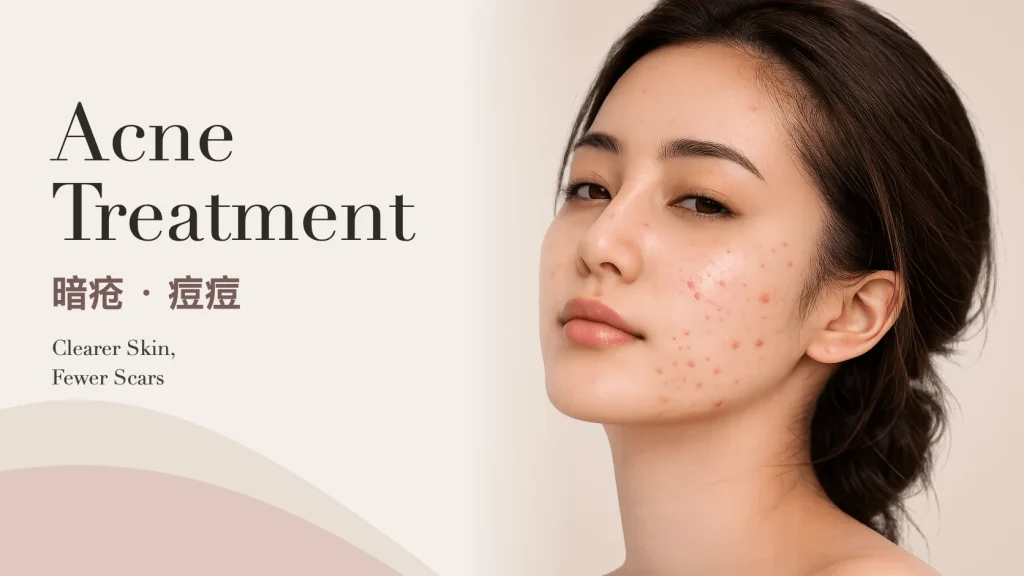
Breakouts that keep coming back, painful spots along the jaw, or dark marks that never seem to fade? What causes acne (暗疮, 痘痘, jerawat), which acne treatments actually work, and how to clear your skin while lowering the risk of scars
Medically reviewed by Dr. Adriene Chee, Medical Director, Verve Clinic. Last updated: 4 November 2026.
You have tried the cleansers, the spot creams and the advice from friends. The breakouts settle for a while, then return, often at the worst possible time. Acne is not a matter of poor hygiene, and it is not something you simply have to put up with. It is a common skin condition with clear causes, and with the right treatment plan it can be brought under control.
Acne is also far from rare. A systematic review in Scientific Reports cites Global Burden of Disease estimates that about 9.4% of people worldwide have acne at any one time, making it the eighth most common skin disease. In this guide, Dr. Adriene Chee, a doctor with more than 10 years of experience treating teenage and adult acne, explains what causes it, which acne treatments the evidence supports, and how we plan acne treatment in Petaling Jaya at Verve Clinic.
What causes acne (暗疮)?
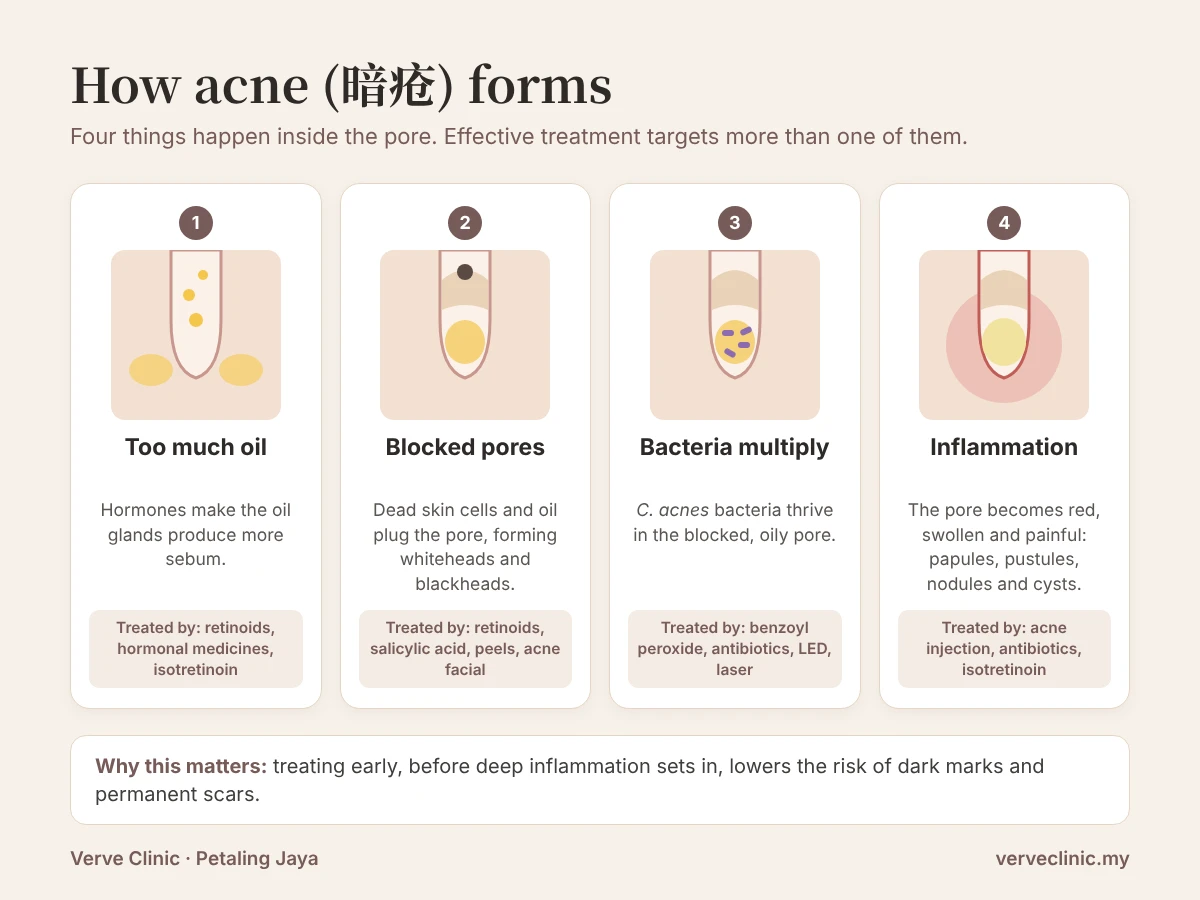
In short: Acne (暗疮 or 痘痘 in Chinese, jerawat in Malay) forms when four things happen inside a pore: too much oil, a build-up of dead skin cells that blocks the pore, growth of acne bacteria, and inflammation. Effective acne treatment targets more than one of these at the same time, and works best when it is started early and kept up consistently.
Each of these four steps can be treated, which is why acne treatment that combines approaches usually works better than relying on one product:
- Too much oil. Hormones, especially androgens such as testosterone, make the oil glands produce more sebum. This is why acne often starts at puberty, and why it can flare in women with polycystic ovary syndrome (PCOS).
- Blocked pores. Dead skin cells are not shed normally and mix with oil to plug the pore. Small plugs form whiteheads and blackheads (comedones).
- Bacteria. Cutibacterium acnes, the bacterium formerly known as Propionibacterium acnes, multiplies in the blocked, oily pore.
- Inflammation. The body reacts to the blocked pore and bacteria, turning it into a red, swollen and sometimes painful spot.
Other factors can trigger or worsen acne, including genetics, stress, poor sleep, heavy or oily skincare and make-up, Malaysia’s heat and humidity, and picking at spots. Diet can play a part for some people: in a Malaysian study in BMC Dermatology of 88 young adults, those with acne ate a diet with a higher glycaemic load and had milk and ice cream more often than those without acne.
Types of acne: from blackheads to cysts
Acne ranges from a few blackheads to deep, painful cysts. Knowing which type you have helps decide the right acne treatment.
| Type of acne | What it looks like | What usually helps |
|---|---|---|
| Whiteheads and blackheads | Small closed (white) or open (dark) bumps, not red or painful | Retinoids, salicylic acid, chemical peels, acne facial |
| Papules | Small, red, tender bumps | Benzoyl peroxide, retinoids, antibiotic gels, LED |
| Pustules | Red bumps with a white or yellow centre of pus | Benzoyl peroxide, topical or oral antibiotics, peels |
| Nodules | Large, hard, painful lumps deep under the skin | Acne injection, oral medicines, isotretinoin |
| Cysts | Deep, soft, pus-filled lumps that can leave scars | Acne injection, isotretinoin, early medical treatment |
Red bumps without blackheads or whiteheads, together with flushing and redness, may be rosacea rather than acne. Our guide to rosacea treatment explains the difference.
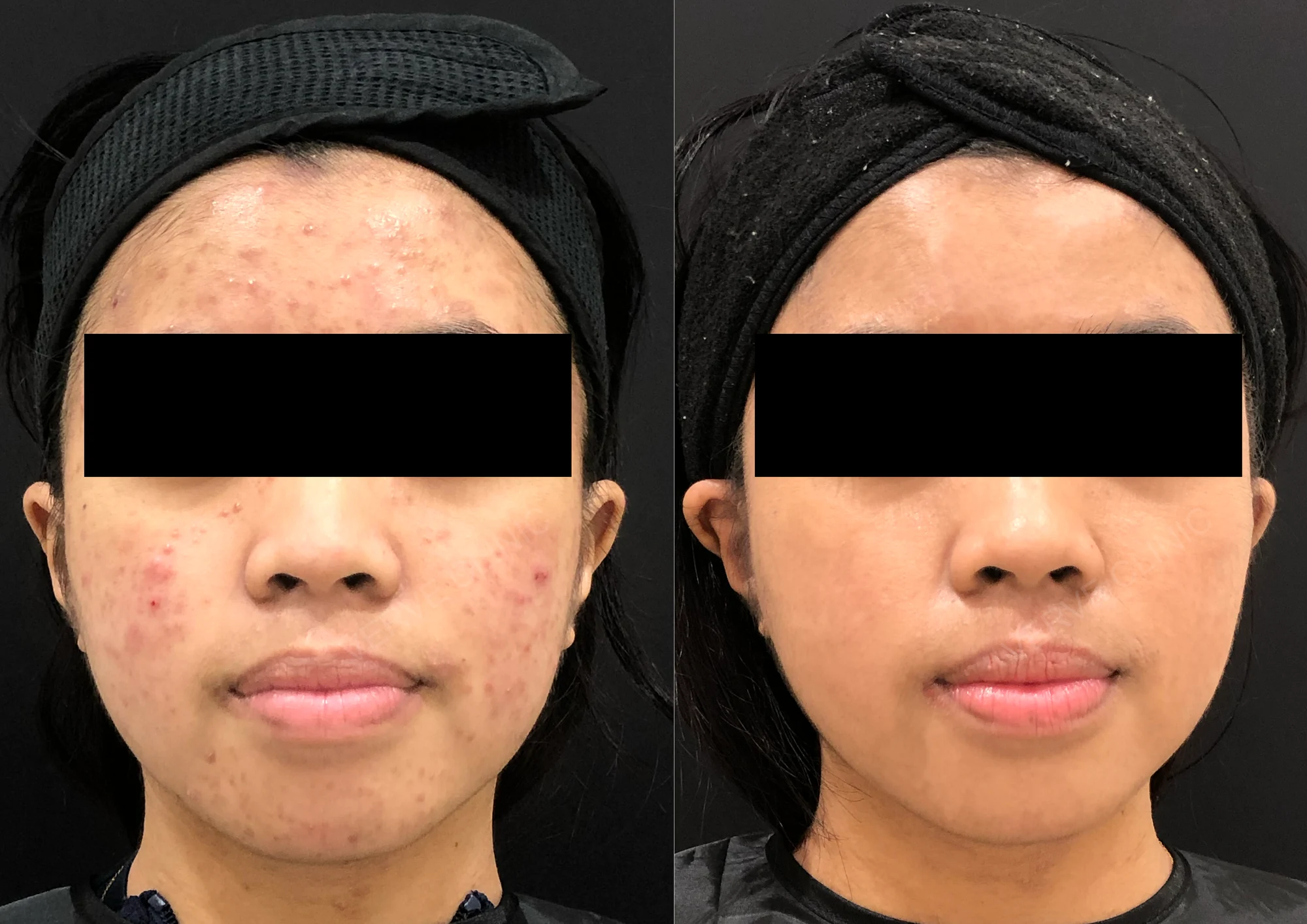
Acne treatment before and after
This is a real patient treated at Verve Clinic. Results vary from person to person.
Which acne treatments actually work?
The American Academy of Dermatology’s 2024 acne guidelines give their strongest recommendations to benzoyl peroxide, topical retinoids, topical antibiotics, oral doxycycline and, for severe or scarring acne, oral isotretinoin. They also support salicylic acid, azelaic acid, combined contraceptive pills and spironolactone, and recommend steroid injections for larger, painful spots.
At Verve Clinic, we combine these medical treatments with in-clinic procedures, so that your plan targets several causes of acne at once.
| Acne treatment | How it helps | Best for |
|---|---|---|
| Prescription creams and gels | Retinoids unblock pores; antibiotic gels and benzoyl peroxide reduce bacteria and inflammation | Most types of acne, and to prevent new breakouts |
| Oral antibiotics | Reduce bacteria and inflammation from within; used for a limited course, together with creams | Moderate to severe inflamed acne |
| Hormonal treatment | Certain contraceptive pills or spironolactone reduce the hormonal drive to the oil glands | Women with hormonal or jawline acne |
| Isotretinoin | Shrinks the oil glands and treats all four causes of acne | Severe, scarring or stubborn acne that has not responded to other treatment |
| Acne facial | Deep cleansing, machine microdermabrasion, safe extractions and LED light therapy | Blackheads, whiteheads and mild inflamed acne |
| Chemical peel | Medical-grade acids clear pores, reduce oil and fade marks | Comedones, mild to moderate acne and dark marks |
| Acne injection | Anti-inflammatory medicine injected into a single large spot | Painful nodules and cysts that need to settle quickly |
| Fotona laser | Nd:YAG laser energy targets the oil glands and acne bacteria to calm inflammation | Persistent inflamed acne, alongside other treatment |
| PicoWay laser | Breaks up pigment and refines skin texture | Dark marks and early scarring after acne |
Prescription creams and gels. Retinoids are often the foundation of acne treatment: they help unblock pores and prevent new spots. Antibiotic gels are always combined with benzoyl peroxide to stop the bacteria becoming resistant. These usually take 6 to 12 weeks to reach their full effect, so consistency matters.
Oral antibiotics. For moderate to severe inflamed acne, a course of oral antibiotics can bring breakouts under control. Guidelines recommend keeping the course as short as possible and combining it with creams, to reduce the risk of antibiotic resistance.
Hormonal treatment for women. If your acne is linked to hormones, certain combined contraceptive pills or spironolactone can reduce the hormonal signals that drive oil production. Your doctor will check whether these are suitable for you.
Isotretinoin. This is one of the most effective treatments for severe, scarring or stubborn acne, and it can give long-term clearance. It must be prescribed and monitored by a doctor, with regular reviews and blood tests where needed. Pregnancy must be avoided during treatment and for a period afterwards, because the medicine can harm an unborn baby.
How we plan your acne treatment at Verve Clinic
No two patients have the same acne, so we build your plan around your skin type, the type and severity of your acne, your triggers and your lifestyle. Most of our patients notice an improvement after 1 to 2 sessions of acne treatment, and the number of sessions you need depends on how severe your acne is.
- Assessment. Your doctor examines your skin, grades your acne and asks about your skincare, medicines, diet, stress and, for women, your periods.
- Finding the triggers. If your acne may be hormonal, we can check for PCOS and other hormone imbalances.
- Your acne treatment plan. We combine the right medicines with in-clinic treatments such as an acne facial, chemical peel, laser or acne injection.
- Skincare at home. We recommend a simple routine that supports your treatment rather than irritating your skin.
- Review and maintenance. We review your progress, adjust the plan, and help you keep your skin clear once the breakouts have settled.
A note from Dr. Adriene Chee: “Acne needs consistency. A treatment session can calm a breakout, but lasting results come from following your plan, using your skincare at home every day, and making lifestyle changes that keep breakouts from coming back, such as better sleep, managing stress, watching sugary foods and dairy, and not picking at your skin. When patients stay consistent, the results last.”
Acne treatment for adult and hormonal acne
Acne is not only a teenage problem. Many adults, especially women, develop acne in their twenties, thirties or later. Hormonal acne typically appears along the jawline, chin and neck, and often flares before a period.
If your acne comes with irregular periods, excess facial or body hair, thinning hair or weight changes, it may be linked to polycystic ovary syndrome (PCOS) or another hormone imbalance. Treating the skin alone may then give only short-term results. We can check your hormones as part of our hormone care, so that both the cause and the acne are treated.
Skincare and lifestyle habits that support acne treatment
In-clinic acne treatment and medicine work best when your daily habits support them. These simple steps make a real difference:
- Cleanse gently, twice a day. Harsh scrubs and over-washing irritate the skin and can make acne worse.
- Use non-comedogenic products. Choose a light moisturiser and sunscreen labelled non-comedogenic, especially in Malaysia’s humid climate.
- Do not pick or squeeze. Picking pushes inflammation deeper and is one of the main causes of dark marks and scars.
- Watch your diet. Cutting down on sugary drinks, sweets and, for some people, dairy may help.
- Sleep and stress. Poor sleep and stress raise stress hormones that can trigger breakouts.
- Be patient and consistent. Give any new routine or medicine several weeks to work before judging it.
How to prevent acne scars
The best way to prevent acne scars is to start effective acne treatment early. In a study of 1,972 patients in the Journal of Drugs in Dermatology, 43% had acne scars, and 69% of those with scars had only mild or moderate acne. The longer the delay before effective treatment, the higher the risk of scarring, which the authors describe as a key risk factor that can be changed.
It also helps to know the difference between dark marks and scars. Flat brown or red marks left after a spot (post-inflammatory hyperpigmentation) are very common in Asian skin and usually fade with time and treatment such as peels or PicoWay laser. True scars change the texture of the skin, leaving pits or dents, and need dedicated treatment.
If you already have acne scars, we offer treatments matched to the type of scar, including subcision, TCA CROSS for ice pick scars, Matrix RF microneedling and Dermapen microneedling. Active acne should be under control first, so that new breakouts do not undo the improvement. Our guide to acne scar treatment explains each type of scar and how it is treated.
| Acne treatment quick facts | |
|---|---|
| First improvement | Usually after 1 to 2 sessions |
| Number of sessions | Depends on the severity of your acne |
| Creams and medicines | Usually 6 to 12 weeks for full effect |
| In-clinic options | Acne facial with microdermabrasion and LED, chemical peel, acne injection, Fotona and PicoWay laser |
| Medical options | Prescription creams, oral antibiotics, hormonal treatment, isotretinoin |
| Home care | A simple skincare routine planned with your doctor |
| Key to success | Consistency, plus lifestyle changes |
When should you see a doctor for acne treatment?
It is worth seeing a doctor rather than continuing to try new products on your own if:
- your acne has not improved after 2 to 3 months of over-the-counter products
- you have painful nodules or cysts
- your acne is leaving dark marks or scars
- acne appeared suddenly in adulthood, or comes with irregular periods or excess hair
- acne is affecting your confidence, mood or daily life
Early acne treatment is easier, gives faster results and lowers the risk of permanent scars.
How much does acne treatment cost in Malaysia?
The cost of acne treatment in Malaysia depends on the type and severity of your acne, the in-clinic treatments you need and whether you need prescription medicine. Mild acne may need only a few sessions, while severe acne needs a longer plan. That is why we give a personalised quote after your consultation, rather than a one-size-fits-all package.
Dark marks left after acne are one type of pigmentation. Our guide to melasma (黄褐斑) and pigmentation explains how they differ from melasma and other spots, and how they fade with treatment.
Frequently asked questions
What is the most effective acne treatment?
There is no single treatment that suits everyone. The most effective acne treatment is a plan matched to your type and severity of acne, usually combining medicine or skincare that targets more than one cause with in-clinic treatments, and kept up consistently.
How long does acne treatment take to work?
Most of our patients notice an improvement after 1 to 2 sessions of in-clinic acne treatment. Creams and medicines usually take 6 to 12 weeks to reach their full effect, so it is important not to give up too early.
How many sessions of acne treatment will I need?
It depends on the severity of your acne. Mild acne may need only a few sessions, while moderate to severe acne needs a longer plan. Your doctor will advise after assessing your skin.
Can acne be cured permanently?
Acne can be cleared and kept under control, and many people grow out of it. Some, especially adults with hormonal acne, need ongoing maintenance with skincare or medicine to stop breakouts returning.
Is isotretinoin safe?
Isotretinoin is very effective for severe or scarring acne, but it must be prescribed and monitored by a doctor. Pregnancy must be avoided during treatment and for a period afterwards, and blood tests are usually checked. Common side effects include dry lips and skin.
Do antibiotics for acne cause resistance?
They can if used for too long or on their own. That is why guidelines recommend limiting oral antibiotics to the shortest effective course and always combining them with a topical treatment such as benzoyl peroxide.
Can hormonal acne be treated?
Yes. For women with hormonal acne, often around the jawline or before periods, treatments include certain contraceptive pills and spironolactone. We may also check for polycystic ovary syndrome (PCOS) or other hormone imbalances.
What does an acne injection do?
An acne injection places a small amount of anti-inflammatory medicine directly into a large, painful pimple, nodule or cyst. It usually flattens within a few days, which also lowers the risk of a scar.
Should I pop my pimples?
No. Squeezing or picking pushes the inflammation deeper into the skin, which increases the risk of dark marks and permanent scars. If a spot needs to be extracted, it is safer to have it done in a clinic.
Does food cause acne?
Diet is not the main cause, but it can play a part for some people. A Malaysian study found that young adults with acne ate a diet with a higher glycaemic load and had milk and ice cream more often than those without acne.
Is it acne or rosacea?
Rosacea causes redness, flushing and red bumps, but without blackheads or whiteheads. It needs a different approach from acne, so it is worth having a doctor confirm which one you have.
Can acne treatment remove acne scars?
Clearing active acne prevents new scars, and dark marks often fade with treatment. Established scars need dedicated scar treatments, such as subcision, TCA CROSS or RF microneedling.
Is acne treatment safe for darker or Asian skin?
Yes, when the treatment is chosen and adjusted for your skin type. Asian skin is more prone to dark marks after inflammation, so we choose treatments and settings that lower this risk.
What are 暗疮, 痘痘 and jerawat?
They all mean acne. 暗疮 and 痘痘 are common Chinese terms, and jerawat is the Malay term.
How much does acne treatment cost in Malaysia?
It depends on the type and severity of your acne, and on the treatments and medicines you need. WhatsApp us for a personalised quote after your consultation.
Ready for clearer skin?
If you are looking for acne treatment in Petaling Jaya, Verve Clinic welcomes patients from Kuala Lumpur, PJ and across the Klang Valley. A doctor will assess your acne, look for the triggers behind it and plan acne treatment that suits your skin, whether that is medicine, in-clinic treatment or both. You can read more about our acne facial and acne injection, or WhatsApp us to arrange your consultation and a personalised quote.
About the author
Dr. Adriene Chee is the Medical Director of Verve Clinic in Petaling Jaya. She has more than 10 years of experience, including treating teenage and adult acne. Her qualifications include an MD from the National University of Malaysia (UKM), a Postgraduate Diploma in Dermatology (Bangkok) and an LCP in Aesthetic Medicine. Meet our team.
This article is general information, not medical advice. Results vary from person to person. Please discuss the benefits and risks of any treatment with a qualified doctor.